Pacific School of Inquiry and Innovation

My EDtech class had the opportunity on Tuesday to visit the Pacific School of Inquiry and Innovation or PSII (they pronounce it sigh). An independent school with 85 students, it is nestled into an office building on Douglas St. in downtown Victoria. Founded by Jeff Hopkins in 2013, PSII offers an alternate learning structure with a personalized inquiry based curriculum model. Victoria’s newest highschool (grades 9 – 12) still meets BC graduation requirements for a Dogwood Certificate. Check out Jeff’s TEDx talk below!

So how is the inquiry model practiced at PSII different from other mainstream public and private schools?

  • Curriculum is co-created by student and teacher
  • Learning path is curiosity driven
  • Learners are grouped according to what makes sense, whether thats by interests, similarities or differences. Grouping is fluid and students from all grade levels interact
  • School consists of many micro-environments ranging from a quiet sensory room to a wide open study space with the constant murmur of voices much like a coffee shop atmosphere
  • Learners encouraged to develop projects based on their own inquiries
  • Learners encouraged to access mentorship and contribute to society outside of the school walls
  • A combination of face-to-face and virtual learning experiences
  • Learners develop their own Physical Health Education plan and have the opportunity to walk over to the YMCA for a supervised workout daily.

We spent the first part of our tour learning about how PSII operates, each student has their own online portfolio, a compilation of their learning goals and achievements. Teachers, students and parents all have access to this e-portfolio.

Along with the curricular competencies outlined in the BC curriculum PSII has their own set of competencies for their learners. Below is a picture of a poster with PSII’s competencies that can be found at various places around the school.

The second part of our tour was spent independently exploring the school and talking with the students. I had the opportunity to talk with two students and one teacher.

The students showed me what they were currently working on as well as the weekly schedule. PSII offers direct instruction once a week for subjects like math. Each student also meets with their support teacher once a week to go over their progress and set new learning objectives for the next week, the student to teacher ratio is about 15:1 with no support staff.

The students that I chatted with told me that they spend the majority of their days on their computers (which are included in tuition), sitting in small groups of 4 or 5 or alone in the silent study area. There are also students that spend the majority of their days off the computer creating in the art/music studios. It all depends on the personalized learning path of the student. I only talked with two students but they both referred to mainstream public school as “scary”, there was an overarching feeling of calmness throughout the school and I can see how this model would work well with teens that struggle with both generalized and social anxiety.

The two students also preferred to call PSII an independent school rather than a private school as it made it sound “elitist”, I think that this goes with seeing PSII as a test model for inquiry based education. Seeing it as the education method of the 21st century. Not elitist, just ahead of its time.

I think that Inquiry based learning should be an option for any student in public schools. For some students direct instruction may work better and for some the inquiry model, no two students are alike so why have only one learning model? I guess that is what PSII is, an attempt to accommodate every learner based on interests, learning needs and pace.

As an elementary teacher how can I prepare my students to be independent thinkers capable of true independent inquiry? This is a question I will continue to ask as a teacher candidate and beyond.

The SENĆOŦEN Speaking People

WSÁNEĆ territory is diverse, you can find sandy beaches, rocky shoreline and hilltops, coastal bluffs, estuary flatland and the odd open meadowland. The WSÁNEĆ people travelled in small groups between their winter villages on the coast and across parts of their territory on southeastern Vancouver Island, San Juan Islands and the Gulf Islands to gather resources in the hunting and harvesting season.

Plants have always played an important role in the lives of the WSÁNEĆ (wh-say-nuch ) or SENĆOŦEN speaking people. Not only are plants (including seaweed, trees and shrubs) a major source of food they are also used for medicine, materials (plant technology) and the setting for cultural activities. “Plant names and terms related to plant harvesting and processing are a significant component of the [SENĆOŦEN] language” (Saanich Ethnobotany pg. 11), a langauage that is connected to the natural world, its animals, plants and the timing of natural events.

The seasonal harvesting activities are explained in detail in Earl Claxton’s book called The Saanich Year, “each family had it’s own special places and their own favorite resources and activities, but in general the pattern of seasonal rounds were on a 13 moon schedule.” (pg. 25)

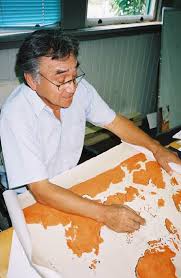
Image result for the saanich year book  earl claxton
Dr. Earl Claxton Sr. with a map of
WSÁNEĆ territory

You can find a detailed moon schedule in my next post…

While researching how to properly pronounce WSÁNEĆ I came across a website called First Voices an online bilingual dictionary and phrase collection with over 1800 words and phrases in the SENĆOŦEN language that allows anyone with internet to access. There is also a link to download the  SENĆOŦEN app from iTunes.


Audio/ Video Editing Workshop with Rich

We had another workshop with Rich McCue today in EDCI 336, this time we focused on Video editing using iMovie, audio editing using garageband and screen capture using Screencastify. We learned how to import a video, then trim and cut it, and transition between parts. We also learned how to add credits and publish it. Using rockband we imported a song and then learned to trim, cut, delete and fade between audio segments. Audacity is another option that can be used on windows as well as Mac. This was my first time working with audio/video editing tools and I found it a bit overwhelming, but like all things I just need to spend some time practicing. Here is a link to Rich’s page with a step by step guide to working with the platforms above.

These tools along with screen capture could also be used by students to demonstrate their understanding of a topic, or, teachers could use these tools to make an online tutorial like Khan Academy and CrashCourse for their students that they can play after a lesson as a refresher. Technology can positively support a teachers role in the classroom so becoming techno-literate is a must for a 21st century teacher.

Here is a couple of ways your students can use video and audio editing software to enhance student learning.

It is important to think about equity when it comes to devices and the internet being used in your classroom. Using an app like iMovie restricts access to a students project. If they do not have access to a Mac device outside of school they would not be able to work or play using the skills they learned at school with iMovie. Tools like wevideo that are cloud-based and free provide access to students outside of school. Kids that may not have access to devices or internet due to financial circumstances would still be able to access their projects at the local library.

All in all though I think that it was great experience to practice using audio/video editing software. As education and technology mesh in a 21st century classroom, being techno-literate is a crucial skill all teachers will need to posses in order to be able to keep up with the next generation. After only 4 Edtech classes it is becoming ever more evident that technology has the potential to be a catalyst for learning, it allows student to express their creativity, show their learning and build understanding.

Video Conference with Ian Landy

Tuesdays class was my first experience with a video conference call, we met with Ian Landy, Principal at Edgehill Elementary in Powell River. Next time I will make sure that I get there early so that I am not in the front row, I was a bit uncomfortable with being on the big screen and the camera moving to wherever the sound was coming from seemed to have a mind of its own.

Ian talked to us about technology as assessment in the form of e-portfolios, fresh grade , just one example of a digital portfolio/ assessment platform (currently being used in SD61) provides educators with a way to report student learning rather than reporting student achievement (what the old fashioned report cards did). It allows teachers to document, capture and communicate learning to parents and students in a secure way, student data is stored in Canada but does spend a few seconds in the US. Through this platform teachers can also share resources and provide their students with formative descriptive feedback. All this capturing and documenting sounds like teachers would spend a lot of time using devices to upload student content, Ian suggested adding archivist as a class job which I think is a great idea that teaches students how to upload to their own e-portfolios. One thing that is great about e-portfolios is that it gives the students the opportunity to document and share their own learning, providing a sense of responsibility. Ian suggested scaffolding independent use of e-portfolios starting at around grade 5 or 6.

Each student comes to class with their own experiences and worldview, no two students are exactly the same so why would we assess them in the same way? As Ian pointed out ” we can’t compare students… E-portfolios allow for personalized achievement”.

Saanich Ethnobotany

Ethnobotany: the scientific study of the traditional knowledge and customs of a people concerning plants and their medical, religious, and other uses.

When researching local plants and their uses I came across Nancy J. Turner an ethnobotanist and emeritus professor (retired professor) at Uvic who has worked with First Nations elders for over 40 years to help retain, document and promote their traditional knowledge of plants and habitats. Nancy has authored, co-authored or co-edited over 20 books about Indigenous foods, material, medicines as well as language and vocabulary relating to plants and their environments.

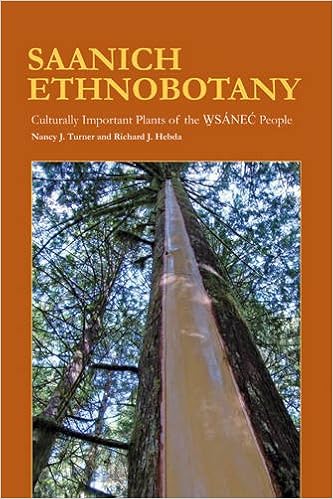
I have decided to use one of her books Saanich Ethnobotany: Culturally Important Plants of the W̱SÁNEĆ People as a handbook for my inquiry journey.

Image result for saanich ethnobotany

It took many years to write this book which is a collaboration with
W̱SÁNEĆ elders Elsie Claxton (Tsawout), Dave Elliott Sr. (Tsartlip), Christopher Paul (Tsartlip), and Violet Williams (Pauquachin) who share their knowledge of habitats, characteristics, qualities and names of over 150 plants found on the Saanich Peninsula. The book has color photos for each plant making it easy to identify them. This book will help me gain insight into an ancient worldview of the plants that sustained the W̱SÁNEĆ people in the place that I now gratefully call home.

A photo of the detailed map on the inside of cover of Saanich Ethnobotany

Edcamp

Today we spent the first couple of hours of our class having our own mini Edcamp session. Edcamp is an unconference where the topics/themes (education based) are chosen by the attendees. The topics are then narrowed down by up-voting the topics that interest you. Rather than having an expert come and talk, the sessions are curated through the collaboration and conversation of the attendees, this allows everyone involved to both share their own experiences and learn from their peers. Edcamp can also be used as a learning tool for teachers to use with their class. More information and resources can be found here.

I chose outdoor learning environments as my Edcamp topic. My group started out by telling each other about our own experiences or lack of experiences learning outdoors. We then relayed examples of outdoor learning environments we have seen. Here are some ideas….

Related image


Image result for outdoor classroom

Through our group conversations it was evident that time spent learning outside was a memorable experience for all of us. We did not get much further than My group ended up getting off topic so I think that if I was going to have my own edcamp with my class I would structure it for them, maybe a list of questions so that if they get off topic they can refer to the questions and get back to purpose of the activity.

Indigenous Ways of Knowing and Being

I thought I would start my open inquiry by looking back through my notes from the Indigenous Studies course I took at Camosun in the fall of 2017 as my Canadian studies pre-requisite to the Teacher Education Program at Uvic. I also found a great e-book called Pulling Together: A Guide for Front Line Staff, Student Services and Advisors  that has a section on Indigenous Ways of Knowing and Being.

Cover image for Pulling Together:  A Guide for Front-Line Staff, Student Services, and Advisors

According to a 2016 stats Canada report there are an estimated
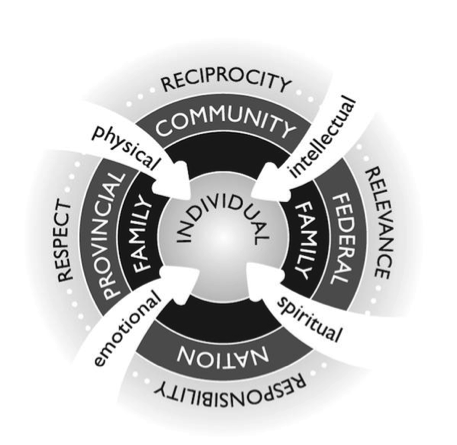
1,673,785  million Indigenous people speaking 70 different languages in what is now known as Canada. While all Nations are culturally unique, they share a common wholistic worldview that sees a whole person (mind, body, spirit) as interconnected to both the land and the other beings that share the land. A worldview is how you construct and make sense of the world around you. As a teacher it is important to understand that each student comes to the school with their own unique worldview. When supporting Indigenous students in the classroom Kirkness and Barnhardt (1991) suggest using the 4Rs to support Indigenous students: respecting Indigenous knowledge, responsible relationships, reciprocity, and relevance. This framework is aimed at post-secondary institutions but I think that it is a useful visual when thinking about how to support not only Indigenous learners but all learners.

""
Indigenous Wholistic Framework

Another great resource State of Aboriginal Learning in Canada  provides a model that includes the following key attributes of an Aboriginal worldview:

• Holistic―It engages and develops all aspects of the individual (emotional, physical, spiritual and intellectual) and the community, and stresses the interconnectedness of all life under the Creator.

• Lifelong―It begins before birth and continues through old age and involves the intergenerational transfer of knowledge.

• Experiential―It is connected to lived experience and reinforced by traditional ceremonies, meditation, storytelling, observation and imitation.

• Rooted in Aboriginal languages and cultures—It is bound to language, which conveys a community’s unique values and worldview while ensuring cultural continuity.

• Spiritually oriented—It possesses a spiritual element which is fundamental to the learner’s path to knowledge. This is manifested in spiritual experiences such as ceremonies, vision quests and dreams.

• Communal activity―It is a communal process in which parents, family, Elders and community have a role and responsibility.

• Integrates Aboriginal and Western knowledge―It is an adaptive process that draws from the best of traditional and contemporary knowledge.

Image result for first nations holistic lifelong learning model
Centring Indigenous intellectual Traditions on holistic lifelong learning. – Scientific Figure on ResearchGate. Available from: https://www.researchgate.net/figure/First-Nations-Holistic-Lifelong-Learning-Model-CCL-2007-p-19-reprinted-with_fig2_319177713 [accessed 30 Jan, 2019]

Native plants and their uses

I love spending time outside, in the spring and summer you will find me in my garden, planting seeds, weeding or watering, watching something the size of a grain of sand turn into sustaining nourishment.

Every year I attempt to grow something new, last year it was broccoli and cauliflower. At the moment my garden is restricted to a city lot, the boundaries seemingly smaller each year with the additions of new raised beds as I experiment with new plants. When I am in my garden working I feel a sense of connection to not only myself but the soil beneath me, it is both meditative and a time to disconnect from technology and follow my thoughts. I often think about what it would take to live off of the land, to be totally self sufficient. I know that I could not survive off of my summer crop and this train of thought always leads me to the Indigenous people of Vancouver Island who survived and thrived without agriculture for millennia.

I had the opportunity in 2018 as part of an Indigenous Studies and Marine Biology course to take part in a native species walk with a Traditional Ecologcial Knowledge (TEK) keeper from the Tsawout first nation on the peninsula.

Image result for tsawout first nation

Read more about the Traditional Territories of the W̱SÁNEĆ  people here 

I was fascinated by the number of usable, edible and medicinal plants all around us. From natural sunscreen to herring roe collection, the native plants of coastal British Columbia have assisted and sustained Indigenous ways of knowing and being since time immemorial. I now pay closer attention when I am on a hike to the plant life around me, I repeat the names of each one that I remember (which are few). It has been a personal goal of mine to gain a deeper understanding of the native plants of coastal British Columbia and their uses so it was an obvious topic for my open inquiry. I plan to not only learn about the plants but to go out and find examples around the Greater Victoria area, an opportunity to connect with nature and myself in the ‘off-season’.

Hitting the higher notes

My musical inquiry for this term is to improve my singing voice. I have always loved to sing, a habit I picked up from my Mom and a sure fire way to know that I am in a good mood. As a kid I would put on The Bodyguard soundtrack, sit really close to the speaker and belt it out, that way I couldn’t hear myself, just Whitney and it felt like it was me singing….”And IIIIIIIIII will always love you”.

I still get shivers every time I hear this song

I never considered myself a good singer, my siblings would get easily annoyed with the out of key sounds that would suddenly puncture the silence, the dinner table was the only place where singing was outlawed, every where else my voice was given free range. Just last year my sister told me that I actually have a pretty good voice and that she always told me I wasn’t good to discourage me from singing all the time. For almost 30 years I thought that not only could I not sing but that I would never be able to.

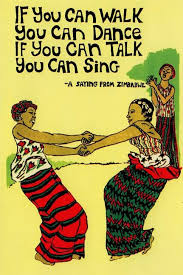
One Christmas my Mom gave me a coaster with a Zimbabwe proverb on it and it changed my perspective on singing and dancing.

I think too many people see singing and dancing as something you can do only if your “good” at it, this idea limits self expression and growth. The proverb doesn’t say anything about singing or dancing well because that is not the point, to me it means that with patience and practice you can do anything…..even sing.

Learning Goals

I am looking forward to adding some online tools to my virtual tool-belt by the end of this semester. Technology already plays a significant role in the daily lives of Canadians and as a teacher I will be preparing my students to be citizens of a digital world. Technology has the potential to empower our learning and expand our understanding. I hope to inspire my students to explore the world around them and beyond with my blog about my own inquiry experiences. A goal of mine for this course is to learn how tech can be used to support personalized and inquiry based learning. Allowing students to build and shape their own understanding with the help of technology can lead to independent learners.

Image result for teachers and technology quotes

Forever a learner and a leader looking to inquire and inspire.